
Your Iron is low. But That's Not the Problem

You've been told your iron is "a bit low" and handed a supplement. So you take it. Weeks pass. Nothing really changes. That is probably because there is a whole lot more to your iron status than what your pathology tests are telling you!

Sound familiar? If it does, there's a good chance the real problem is sitting below the surface.

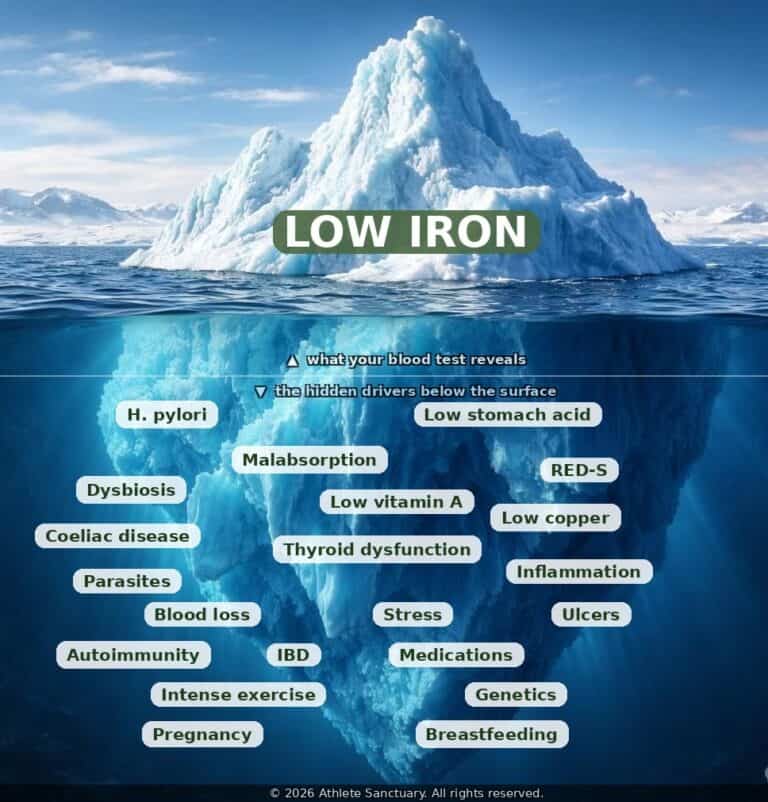
Iron deficiency is one of the most common nutritional issues we see in athletes across all sports, all genders and all levels of competition.1 But iron itself is rarely the whole story. Like an iceberg, what shows up on a blood test is only the visible tip. 

Below the surface lies a deeper set of questions: why is iron low? What is making it hard to absorb, store or use? Until those questions are answered, supplementation is often little more than filling a bucket with a hole still in it.

Here are five of the most common myths we encounter and what the research actually tells us.

Myth 1: "I just need to eat more iron-rich foods"

Diet absolutely matters. But if the issue is absorption rather than intake, adding more steak or spinach to your plate will not move the needle. Iron requires a highly acidic environment to be absorbed in the small intestine. 

Low stomach acid (hypochlorhydria), gut dysbiosis, intestinal parasites such as Giardia or H. pylori, coeliac disease, or long-term stress can all quietly undermine your ability to absorb the iron you eat. Identifying and addressing the root cause, not just the dietary source, is where recovery begins.2

Myth 2: "If I'm not anaemic, my iron is fine"

Anaemia is the end stage of iron deficiency, not the beginning. Long before haemoglobin drops, falling ferritin levels begin to impair oxygen transport, muscle metabolism and cognitive function. Research confirms that endurance performance can decline by 3–4% in iron-deficient but non-anaemic female athletes, with improvements of 20% observed after supplementation.3 

For endurance athletes in particular, the evidence now supports a ferritin threshold of at least 50 µg/L well above the 30 µg/L commonly listed as the lower reference on a standard blood panel.4  

Myth 3: "More iron supplementation is always better"

This one can actually backfire. A single large oral dose of iron triggers a spike in hepcidin, the hormone that regulates iron absorption which suppresses uptake from the very next dose for up to 24–48 hours.5 More frequent, higher doses do not mean more iron reaches your cells.  If imbalances already exist between iron, zinc and copper, more iron can actually make things worse.
Current research supports alternate-day supplementation taken in the morning when hepcidin levels are naturally at their lowest, paired with vitamin C, and well away from coffee, calcium and hard training sessions.2,5

Myth 4: "My GP says I'm in the normal range, so I'm fine"

Standard laboratory reference ranges are built around the general population, not athletes under high training loads. A ferritin reading that looks acceptable in a sedentary adult may represent a meaningful deficit for a runner clocking 80-kilometre weeks or a swimmer in twice-daily training. 

Iron status also shifts with training load, illness, altitude exposure, hormonal cycles and energy availability, meaning a single annual test provides a very incomplete picture.1,6 

Aim to test at least twice a year and more often if you are iron deficient, approaching altitude, or increasing training load significantly.

Myth 5: "Iron deficiency is a standalone problem"

This is perhaps the most important myth of all. Iron deficiency in athletes rarely exists in isolation. Relative Energy Deficiency in Sport (REDs), a state of chronically low energy availability is strongly associated with impaired iron status, as the body down-regulates non-essential processes, including nutrient absorption, when fuel is scarce.7 

Thyroid dysfunction, including subclinical hypothyroidism, is closely linked to both low stomach acid and altered iron metabolism so individuals with iron deficiency can have significantly lower levels of thyroid hormones FT3 and FT4.8

Genetics can also provide useful understanding around iron mobilisation and iron requirements as detected in our myDNA Comprehensive Health Report. Underlying infections such as H. pylori or intestinal parasites compete directly with the host for available iron and can make supplementation entirely ineffective until the infection is resolved.2

iron-deficiency

So, What Should You Do?

Start by asking better questions. Not just "how low is my iron?" but "why is it low, and what is making it hard to correct?"

A thorough investigation, one that looks at a range of markers not just ferritin, paired with an honest conversation about your training load, energy intake, gut health, recovery, calorie intake, mood and stress, is where meaningful answers come from. If you have been supplementing for months without real improvement, that itself is a signal that something below the waterline deserves attention.

Iron deficiency is common, correctable, and often mismanaged. Understanding the full iceberg is the first step toward resolving it properly.

If this resonates let’s chat!

References

1.Peeling, P., & McKay, A. K. A. (2023). Iron regulation and absorption in athletes: Contemporary thinking and recommendations. Current Opinion in Clinical Nutrition and Metabolic Care, 26(6), 551–556.

2. Kardasis, W., Naquin, E. R., Garg, R., Arun, T., Gopianand, Y. S., Karmakar, E., & Gnana-Prakasam, J. P. (2023). The IRONy in athletic performance. Nutrients, 15(23), 4945.

3. Šmid, A. N., Golja, P., Hadžić, V., Abazović, E., Drole, K., & Paravlic, A. H. (2024). Effects of oral iron supplementation on blood iron status in athletes: A systematic review, meta-analysis and meta-regression of randomized controlled trials. British Journal of Sports Medicine, 58(6), 320–329.

4. Solberg, A., & Reikvam, H. (2023). Iron status and physical performance in athletes. Life (Basel), 13(10), 2007.

5. Nolte, S., Krüger, K., Hollander, K., & Carlsohn, A. (2024). Approaches to prevent iron deficiency in athletes. Deutsche Zeitschrift für Sportmedizin, 75, 195–202.

6. Roy, R., Kück, M., Radziwolek, L., & Kerling, A. (2022). Iron deficiency in adolescent and young adult German athletes: A retrospective study. Nutrients, 14(21), 4511.

7. Mountjoy, M., Ackerman, K. E., Bailey, D. M., Burke, L. M., Constantini, N., Hackney, A. C., & Sundgot-Borgen, J. K. (2023). 2023 International Olympic Committee's (IOC) consensus statement on Relative Energy Deficiency in Sport (REDs). British Journal of Sports Medicine, 57(17), 1073–1097.

8. Garofalo, V., Condorelli, R. A., Cannarella, R., Aversa, A., Calogero, A. E., & La Vignera, S. (2023). Relationship between iron deficiency and thyroid function: A systematic review and meta-analysis. Nutrients, 15(22), 4790.

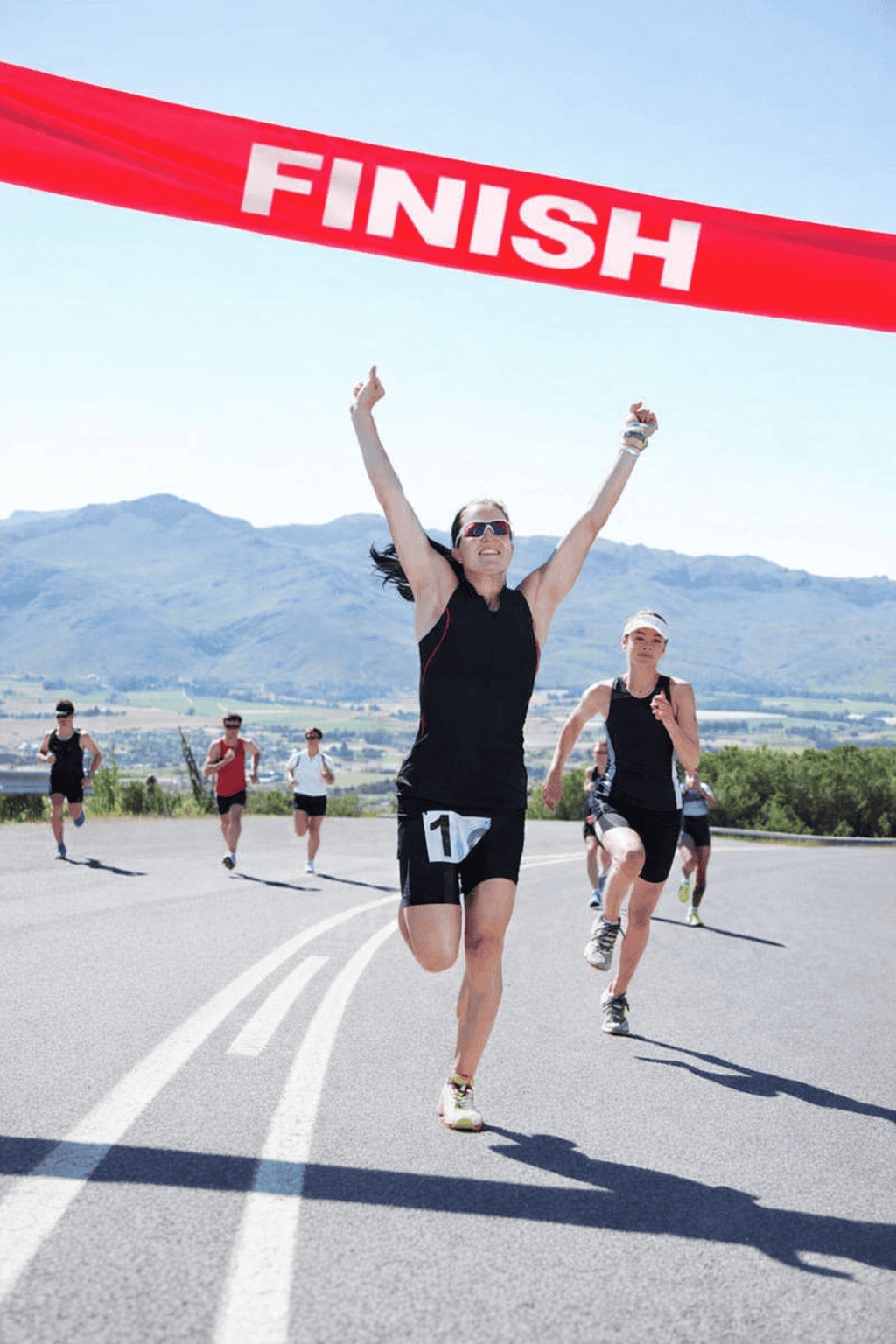
Photo of Kate Smyth running across the line as she finishes the Nagano marathon in 2008.

About the Author

Kate Smyth is a sports naturopath, nutritionist and female-centric running coach. She is the founder of the Athlete Sanctuary - a holistic healthcare clinic for athletes of all levels and sporting codes.

Kate has a thirst for knowledge, with two bachelor's and a master’s degree under her belt. She has been involved in sports for many decades and competed for Australia in the Commonwealth Games and Olympic Games marathons with a personal best time of 2 hours 28 minutes.

About Kate Smyth

From Olympian to Practitioner & Coach

Kate’s path into high‑performance sport didn’t follow the traditional script. A late bloomer and recreational runner, she found her spark during the Sydney 2000 Olympics, watching her idols surge into the stadium. That moment ignited a commitment that would quietly and profoundly reshape the course of her life.

Eight years later, she realised her own Olympic dream, representing Australia in the women’s marathon at the 2008 Beijing Olympic Games.

Her running career spanned the Commonwealth Games, multiple Australian representative teams, and national‑level competition across cross‑country, track, and road racing. With a marathon personal best of 2:28, Kate was one of Australia’s all time fastest female marathoners.

But her journey was far from linear. Significant health challenges forced her to question conventional medicine, sports nutrition and traditional training models. What felt like setbacks at the time became turning points, pushing her to explore deeper, listen more closely to her body, and ultimately develop a more sustainable, female‑centred approach to performance.

These experiences now form the foundation of the work she shares with other women: how to train smarter, nourish deeply, honour physiology, and build resilience from the inside out.

She holds three degrees including a Masters and Bachelor of Health Science (Naturopathy). Kate is an accredited athletics coach with Athletics Australia and a member of NHAA.

Kate’s expertise is widely recognised, leading to regular invitations to speak on podcasts, at seminars, within industry education forums, and across corporate and women’s health initiatives.

Kate Smyth has been featured on

Not quite sure exactly what you need right now. Let's chat